Breast biopsy - nasty but necessary
A breast biopsy can be done in a number of ways, usually under mammography. The hospital didn't give me all that much information, a few diagrams and some warnings. So I thought I'd share my experience here, and hopefully help others when they aren't given much information.
If you get squeamish about needles, medical tests and blood, stop reading now.
My breast biopsy was to see if my calcified ducts, shown clearly in a mammogram, have cancer cells. And if so, what type of cancer cells they are.
This is required to choose the next operative step in treatment - lumpectomy or mastectomy.
This is my nightmarish experience of a breast biopsy, and may not be representative of your test or experience.
The prep appointment
Step 1 - I met with the biopsy doctor at the hospital one day before the biopsy appointment.
I wish I’d had this appointment before I’d taken the Humira (adalimumab) injection (every two weeks), as the one thing she stressed was that there is a not-insignificant risk of infection with this test. They clean everything as best they can, but they can’t guarantee that there are no bugs left behind. If you are taking immune suppressants, it’s best to either do the biopsy between two of the fortnightly doses, or skip the dose before the biopsy.
When she said this, I couldn’t imagine how that would be the case, but after the test was finished, yeah – it’s impossible to sanitize all the areas in the room and on the machine that were impacted by the spash.
She explained that my test would be a combination - a large needle would be inserted under mammography, with the tip on a calcified duct in my breast. (She didn’t say how large the needle was though!) Then 12 biopsies would be taken from within that needle with a vacuum technique. All of this would be done with local anesthetic in a sitting or lying position.
Sounds easy enough. I compared it to the punch biopsy I’d had recently on my leg - quick, easy, just a couple of stitches, and a few days to recover.
I would be attended by the biopsy doctor, several specialist nurses and one cancer specialist - the leader of the breast cancer unit. He’d only be there for the sampling though.
The positioning mammograms
Because the insurance companies here are ridiculously strict, the previous mammography I’d had would not qualify me for treatment coverage: I’d had a horizontal and angled mammogram, the insurance requires horizontal and vertical.
So, first step was to retake those mammograms and take the missing vertical mammogram. Squishing my breast is always painful.
Step 2 - 5 minutes for the setup and scan while standing with the nurses. Done.
Then, I sat in a chair, and was wheeled back to the mammogram machine after they switched the plates. Instead of the solid plate on top, they need one with a hole to allow the needle to go through.
Step 3 - Once I was positioned as closely as possible, the mammogram machine squished my breast again. This time, much, much stronger. This mammogram showed I wasn’t in the right position - re-position the squishing and take the mammogram again. And repeat. They commented that it was good I had larger breasts - the biopsy location wouldn’t have worked with someone smaller.
This was incredibly painful.
Throughout this entire process, you have to stay relaxed, and not moving, and ideally not breathing. Two specialist nurses and a doctor now were here setting me up, and they were fabulous at keeping me calm.
Finally, they had put me in the right position. 15 minutes of being squished in the mammography machine for this setup.
Biopsy start - anaesthetic and large needle in
The machine was programmed - exactly which location the needle should be inserted and the depth to which the needle should go.
Step 4 - The doctor injected a lot of very fast-acting local anesthetic, double the amount that is usually used. I commiserated with one of the nurses who also always needed extra anesthetic because her body was just resistant. It’s not just me!
I kept my face turned away - I’m not good with needles. I’m also terrible when I see blood!
Step 5 - The big needle was then inserted into the machine, and then while two nurses were stroking my arms to try to keep me relaxed, it punched in, and stayed in.
I felt something warm around the area, but didn’t dare look. They had said it might bleed a bit. I had no pain with the injection, only at the nipple because the machine was squishing so strongly.
Step 6 - Yet another mammogram to check that the tip of the needle was correctly positioned in the calcified duct.
This part was another 15 minutes of being squished in the machine.
The cancer specialist turned up at this point, double checked the positioning, and we were ready to start sampling.
Vacuum biopsy samples taken
Step 7 - Now the actual breast biopsy began - 6 sample needles vacuumed out samples from inside the larger needle they hid inside. I was terrified that breathing would be making my breast slip out of the mammography machine, and they had to keep reassuring me that I was doing really well and not moving.
Each of these six samples took time - each sample needed to be selected in the machine, then the sample sucked out, then deposited into the test tube (or whatever they used – I didn’t look). The nurses commented that they could ‘hear’ that some of the samples were calcified - they sound different to non-calcified samples when they are dropped in.
I don’t want to repeat this test!
Step 8 - Then, time for another mammogram to see how things are going. Everyone goes behind the protective screen and looks at the monitor. This was when I saw the doctor’s gloves and sleeves - completely covered in blood. Crap. During the second half of the procedure, I had a lot more trouble staying relaxed and breathing ‘normally’, knowing how much blood was leaking out.
This mammo was unclear - they couldn’t see anything through the pool of blood that had developed inside the breast. Yay. “May as well keep going” was the decision - they couldn’t re-position anyway if they couldn’t see anything.
Step 9 - So, 6 more samples done. 20 minutes for all twelve samples to be collected, plus the midway mammo.
Normally, another mammo is done at the end, but they said there was no point – the blood pool inside was too large.
The specialist declared he reckoned there was no cancer. The biopsy doctor disagreed and said the samples sounded cancerous as they hit the test tubes.
The first clean up
Step 10 - Time to remove the needle. This required two nurses behind to stabilise me, and an extra nurse who kept my eyes looking to the side, away from the machine, away from the fourth nurse and doctor. The specialist had already disappeared.
Needle out, mammogram machine released - I can breathe without fearing I might move! Breast biopsy over, or so I thought.
Step 11 - Doc had a wad of bandages pressed to my breast, and she was wonderfully careful not to put pressure on my ribs (this procedure is a nightmare with costochondritis - a guaranteed flare!)
All up, about one hour in the mammogram machine getting squished.
I let them clean up for about 5 minutes before I dared to look around. OMG.
The top mammo plate has quite high raised edges, and was filled with a deep pool of blood. The attachment point to the machine was submerged, as was the lower plate and its attachment point. (This is why it can’t be completely sanitized.)
The rolling wagon that the doc doing the biopsy had next to her also had a deep pool of blood covering it. Blood had splattered the doc’s clothes and shoes, and was all over the floor.
I half wish I could have taken a photo. It truly looked like the aftermath of a medieval torture chamber. Or perhaps a room in a Silent Hill game.
The final mammogram
Two nurses were cleaning up as quickly as they could - they need to take two more mammograms (horizontal/vertical) of my poor breast to finish.
Step 12 - 10 minutes of compression, and the doc let go, ready for the test. Only a few seconds later, and the fountain started again. This time, all over my trousers and shoes. Another 10 minutes of compression - seemed to have stopped the flow.
Back into the machine. Horizontal was ok (5 minutes), vertical (also 5 minutes), started the blood flowing again – all over the machine (again), the floor (again), and me.
My trousers and shoes were soaked.
Step 13 - Once they’d got the two images, it was another 15 minutes of the doc providing compression to try and stop the bleeding - her poor hands were shaking at this point.
The specialist came back in and said that he’s not sure they had any usable samples. That I’d probably have to repeat this in 3-4 weeks, after the hematoma had healed and they could see again.
Crap.
The recovery wait
After the breast biopsy, they don’t let you go home immediately.
Step 14 - First they tape the wound, put a bandage with iodine goop on it, and then a compression strap around your upper chest. Then you lay down, they put an ice pack over the site, and a sandbag on top to provide even more compression. And you stay there for an hour while they keep coming in to check on you.
One of the nurses was worried because I’d lost so much blood - they hadn’t any stock of my blood type on hand.
Sent home
Do not use the arm on that side. Nothing - no lifting of a kettle, no reaching for your glasses, no moving it to put clothes on - do everything with your other side. Absolutely no cleaning, cooking, garden work, driving, nothing. Not even computer use!
This compression bandage must stay on for 24 hours, if you can manage it. No shower for 3 days.
Apply ice for 20 minutes every few hours on the first day.
Thankfully, it was my left side. As a right-hander this would have been impossible!
Walking to the entrance of the hospital get picked up was horrible. Every jiggle with every step hurt, and I couldn’t breathe with that bandage!
I completely understood the intructions to limit movement when I got home - I couldn’t reach my arm forward without pushing on the site, not even to type at a keyboard. Large breasts really get in the way. Bah - I had to take sick leave from my part time position, something I had hoped to avoid until the actual operation.
Overnight with compression
It wasn’t a good night. I’m a belly sleeper - impossible position, even now, nearly a week later. Lightly dozing on my back was the best I could do.
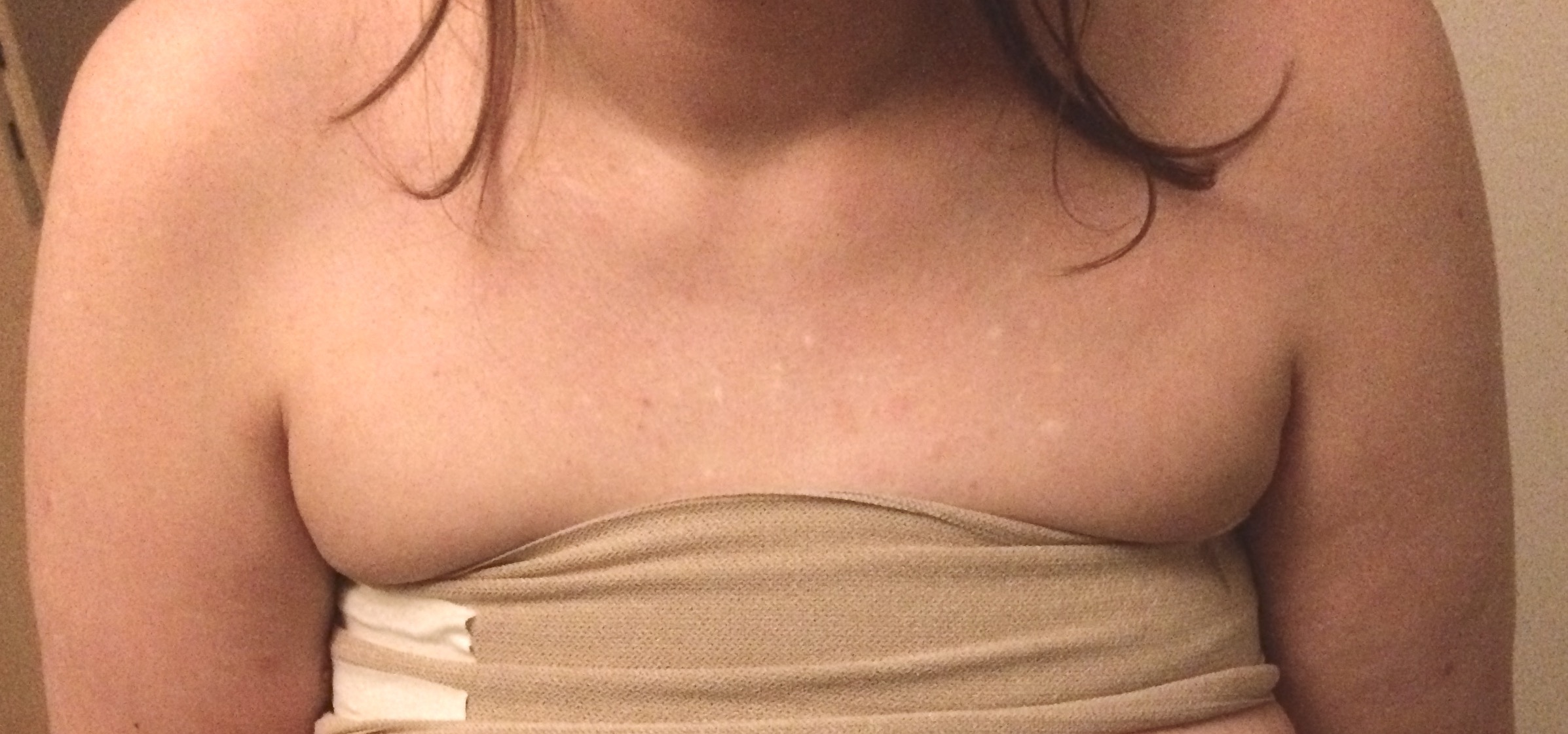 Step 15 - The compression bandage had rolled, and pushed into my spine, making the outside of my right arm and hand numb. I had to take it off in the morning - it was too painful, and the longer the numbness stuck around, the greater the risk of damage. I managed about 18 hours, I think.
I could breathe again!
To get the feeling back into my numb arm and hand, massaging around the spine and shoulder blades with tennis balls in socks against the wall worked. I would have used a heat pack to relax those muscles, but not the day after the breast biopsy - it needs to be kept cool.
Large breasts really get in the way. Every time I even slightly moved my left arm, it brushed against the biopsy site. Extremely painful!
The second night, I had to sleep occasionally on my right side. By the third night, the costochondritis had flared - never sleep in one position where the ribs are compressed, so regularly. Costo hacks and ibuprofen to the rescue. Just one day and night of pain from that.
Bruising and the hematoma
 It’s now been 6 days, and I don’t know the results yet (weekends and a public holiday). Hopefully I’ll find out tomorrow. The insurance company will not pay for any treatments until cancer cells have been found in the breast biopsy under a microscope.
Stupid bureaucracy.
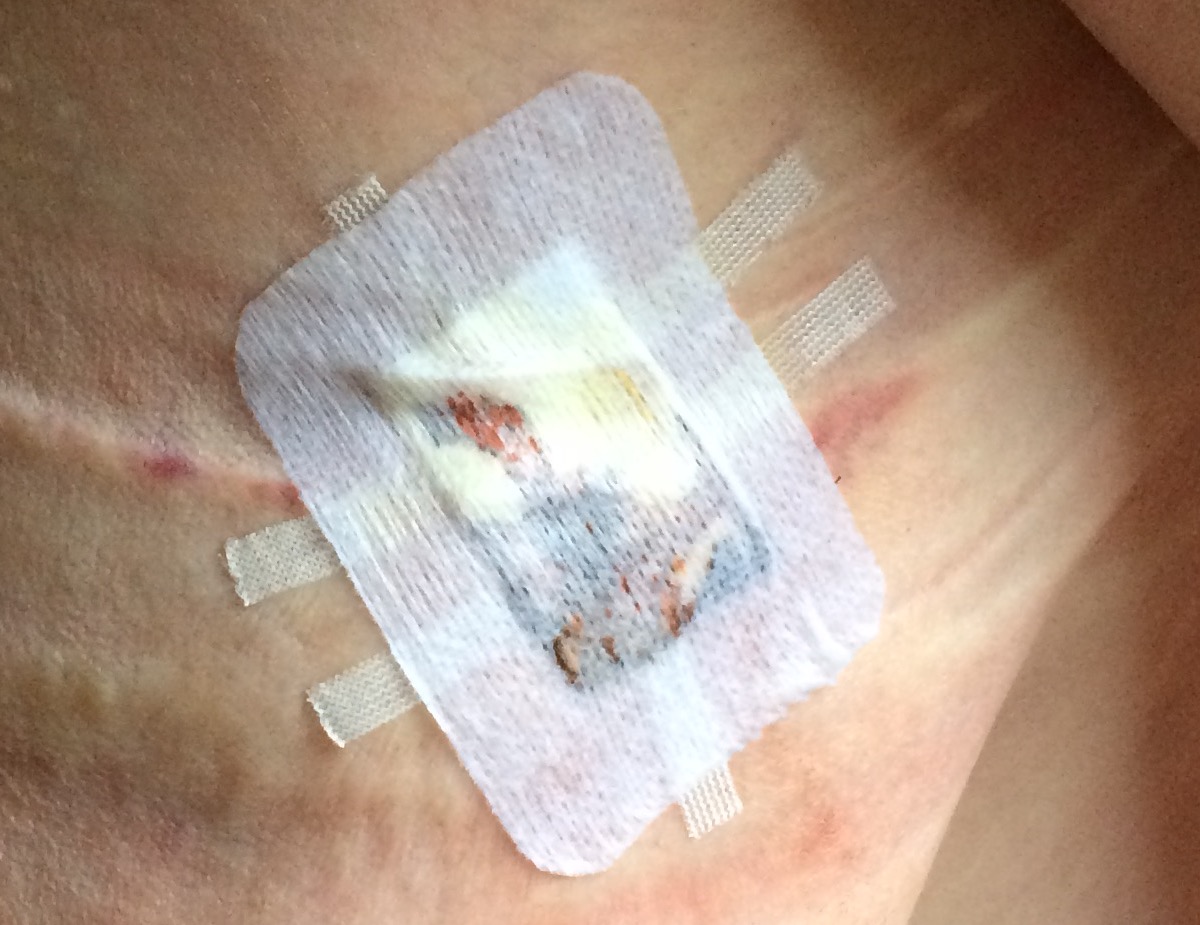
I’ve bruised spectacularly. And there is a solid warm lump - the bleeding inside has formed a large hematoma, which will be disintegrated over time. 3-4 weeks, according to the doctor. I’ve read that exercising helps it go a little faster, but it’s still too sore to use my left arm.
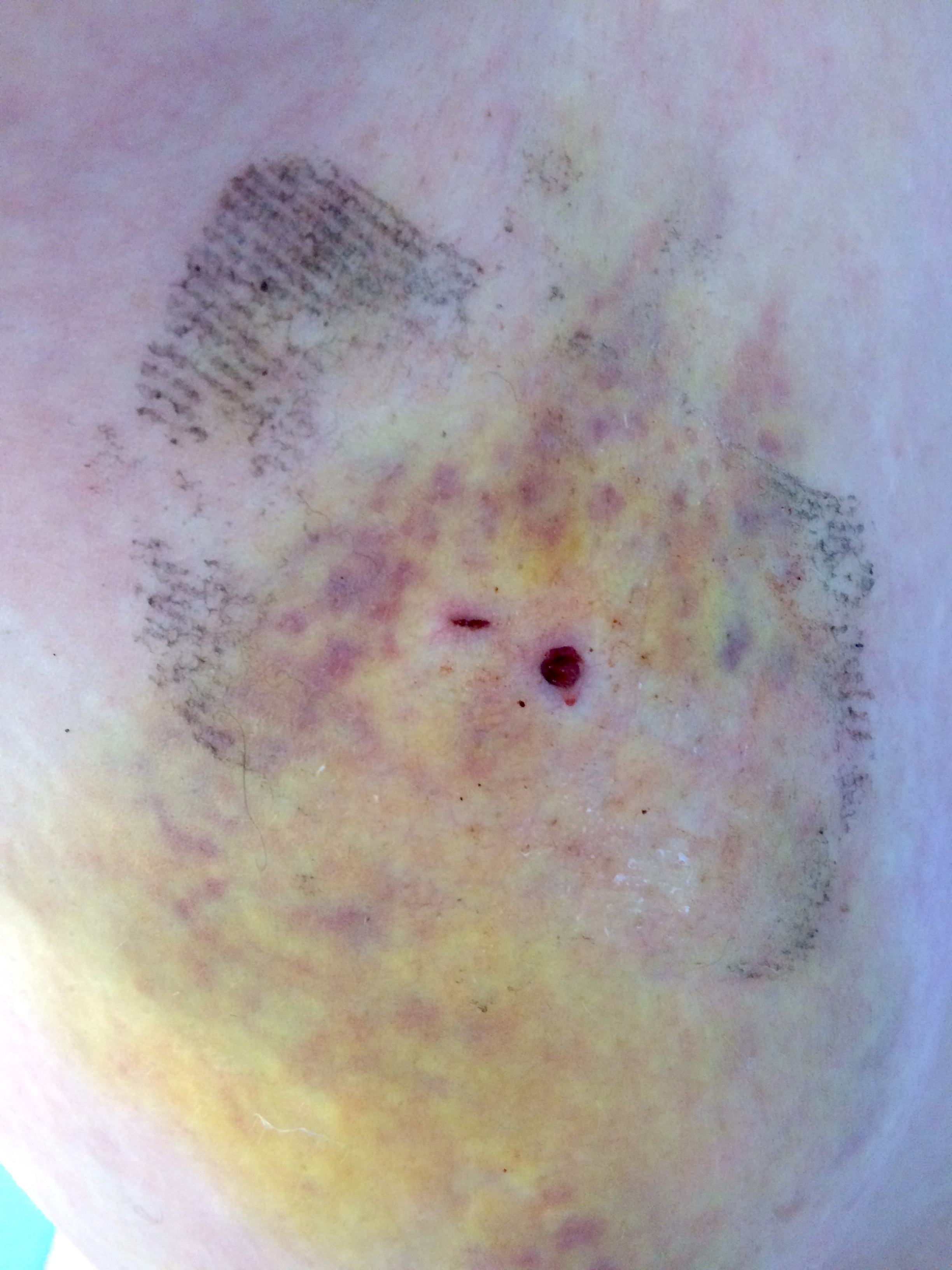 Step 16 - I took the covering plasters off on the 4th day, and felt sick to my stomach while doing so! I chose not to shower, because it started bleeding a little - the scab was stuck to the tape. I’ve changed this bandage each day since, and the bleeding has finally stopped (crossed-fingers). I haven’t been game enough to try to get rid of the black sticky residue from the initial dressing.
The needle hole is about 6mm in diameter - that’s a huge hole. No wonder it hit a blood vessel.
Now, I need to have just a little more patience to get the results tomorrow. Hopefully they will find cancer cells, and we can start the treatment.
Results update: Cancer cells were found in all of the samples, in the ducts. So, definite DCIS. This is ok. It’s clear, easily treatable, with a defined path of treatment to follow, and, the operation on that side (at least) is covered by insurance.
The biopsy doc and my radiologists were right. And the breast cancer specialist was very wrong. Also about not having usable samples.
This is not reassuring - he will be the one to lead the breast operation.