DIEP recovery - 1.5 years post DIEP
A rundown of the DIEP operation I had to remove the cancer in my left breast.
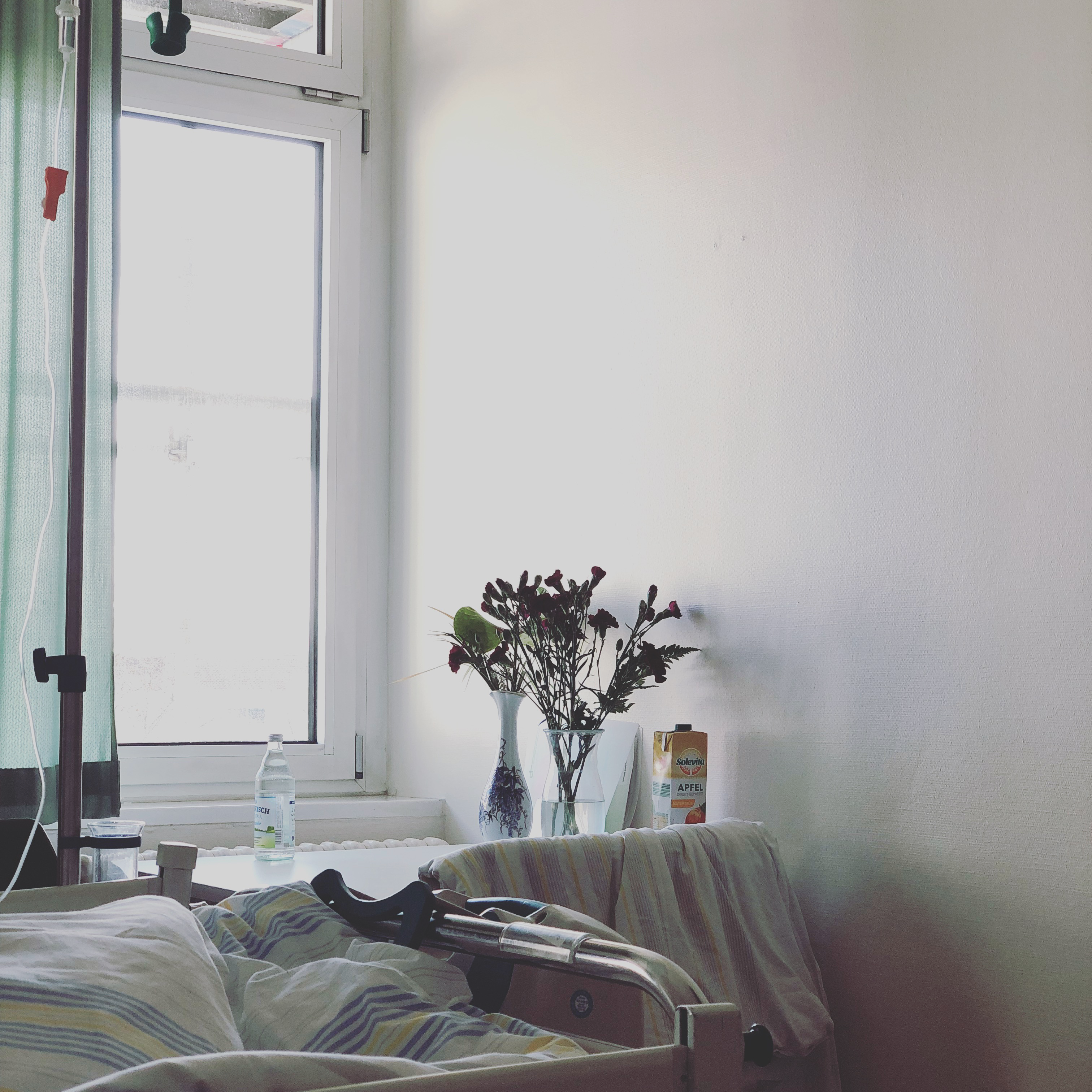
I had to take quite a lot of time off, both from work and from personal writing. Recovering from the mastectomy and DIEP was not straightforward. There were many significant setbacks, both directly because of the operation, as well as many difficult external factors that impacted recovery.
Of course, such a massive cancer operation will have a long recovery. Compounded with multiple other chronic illnesses, it’s even harder.
Recovery is slow - you need patience and a lot of help.
Constant GP visits
I had to visit the doctors three times a week for a wound check for the first few months.
I had one spot in the middle of my tummy cut that had the local doctors worried for a month or so - it simply refused to close! And I got a small infection in the cut on one hip. But both problems were eventually resolved, with antibiotics, drainage and the most expensive silver-impregnated dressings (100 euros for 10!) Also disturbing, was how my body constantly spat out the stitches over the next 12 months from the breast.
The months after the op were a grind - washing the compression clothing daily, dragging my poor stiff body to the doctors every few days, changing dressings, sponge baths and no showers, never raising my arm to minimise any additional trauma to the transplanted breast. The bandage industry must have loved me - there was only one brand I didn’t react badly to!
I dove deep into games playable with one arm to distract from the pain, broken up by a daily shuffle walk that kept getting a little longer to try to regain some fitness and stamina.
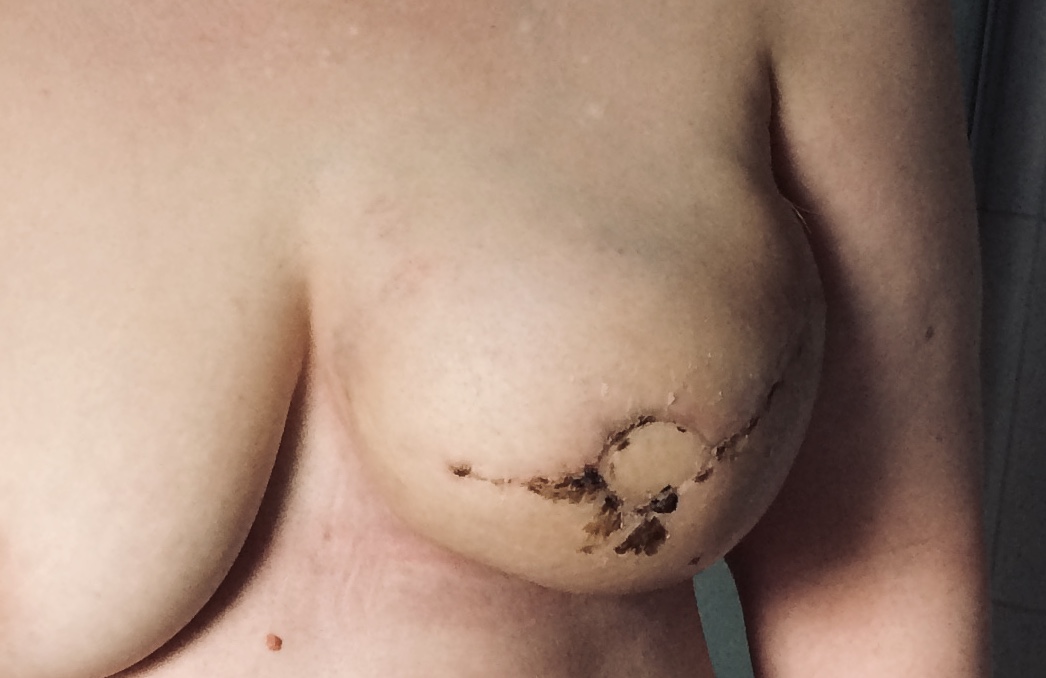 The transplant started out completely solid and positioned very high on my chest. The scabs looked dreadful, and there were a couple of spots that took forever to close. Even at three months I still had to fully dress the scar/scabs.
It took about 6 months for everything to fully close and for physiotherapy/lymph drainage massage to be allowed to start.
Over the last 1.5 years, it has softened with the weekly lymph drainage massage (apart breast fat necrosis - that had to be cut out at about a year), and now hangs almost at the same height and size as my non-transplant side.
Now when I wear a bra (no underwire!) you can’t tell that one side is a transplant, apart from there being no nipple.
Things that help
Get a helper or better, a team
Someone to help you get washed and dressed, change your bandages, help you stand up, cook, clean and wash clothes and the compression clothing… This is invaluable after such an operation.
And when they are not available, make sure the important things are at bench height: clothing, cups, glasses, plates, tea and coffee, milk, snacks, the microwave, wash cloths, soaps, extra toilet rolls - not stretching at all in the early stages helps cuts stay together.
Wear compression clothing
The round-the-clock compression was hell - my skin doesn’t do well without being allowed to breathe. It didn’t help that it was a hot summer. I had so many sweat rashes and dermatitis while under compression.
After 6 weeks I was ‘allowed’ to go around without compression, but kept wearing it for two more weeks because of that spot that refused to close. At this point, I still couldn’t stand up straight, and I needed something to hold the bandages in place more securely on that darned spot on the tummy cut.
The doctors and surgeons believe the extra constant compression greatly helped the healing process.
I still use the compression bras when I need a little more support, or for the days where my chest is sore or holding too much water and not draining the damaged lymph system - they are so comfortable.
Stay bent
I’m not a back sleeper. Or at least I wasn’t. After a DIEP, the only possible sleeping position is on your back. You should sleep with your chest/head raised to stop fluid pooling around the transplant. Plus, to not pull the tummy cut, you need to sleep with a pillow under your legs. So, you end up sleeping on your back in a kind of a V position - I relied on a wedge pillow behind my back and a lymph-leg pillow under my knees and lower legs. I suspect a recliner chair would have made this a lot easier.
For months, I slept on the sofa bed upstairs because it was easier to roll in and out of. It took me about 4 months before I trusted I could safely get myself up from the futon on the floor without damaging anything. And about 12 months before I could sleep on either side, with the help of a body length pillow to prop up the transplant.
I’m still using both pillows - the wedge is ideal on the sofa or in bed for reading with better back support, and the lymph leg pillow is great while I’m working.
Use good quality dressings and bandages
You will need to take your dressings off at least once a day to wash with salty water and disinfect the cuts and scabs. Which means your skin is going to get very annoyed with the adhesive. I found an (expensive) large silicone dressing the best - no ouchiness on removal, and no reaction from my sensitive skin.
The (crazily expensive) silver-impregnated Dracofoam wound dressings were for the holes that refused to close for a few weeks. I used the silicone dressings over them, as the Dracofoam adhesive caused allergic rashes. Thankfully, I could purchase these dressings with my insurance - private, they cost a small fortune. But they were definitely worth it.
Move gently
Around this time, I worked on increasing the distance I could walk. After I got home, walking from the car to the doctors, or from the garage to the house was the maximum I could manage. A week later, I made it to the pokestop half a block down the road from the doctors. At about 4 weeks, it took 40 minutes, but I made it the coffee shop in the middle of the town (normally a 15 minute walk). Pokemon Go gave me goals and distraction.
At 8 weeks I had to shovel snow even though I wasn’t ‘allowed’ to by the docs - you are legally required to keep your paths clean in Germany, and my partner was working in a town 5 hours away. I took it slowly and spread it out over the whole day.
At 10 weeks, I was able to walk around the plateau on which I lived (normally 60 minutes, but it took a good 2 hours). At 12 weeks, I could walk to my physio 40 minutes down the hill. At 4 months, I could also walk back, although it killed me for the rest of the day.
You will not be back to your normal self after 6 weeks, which is the typical period doctors suggest you’ll need. They lie.
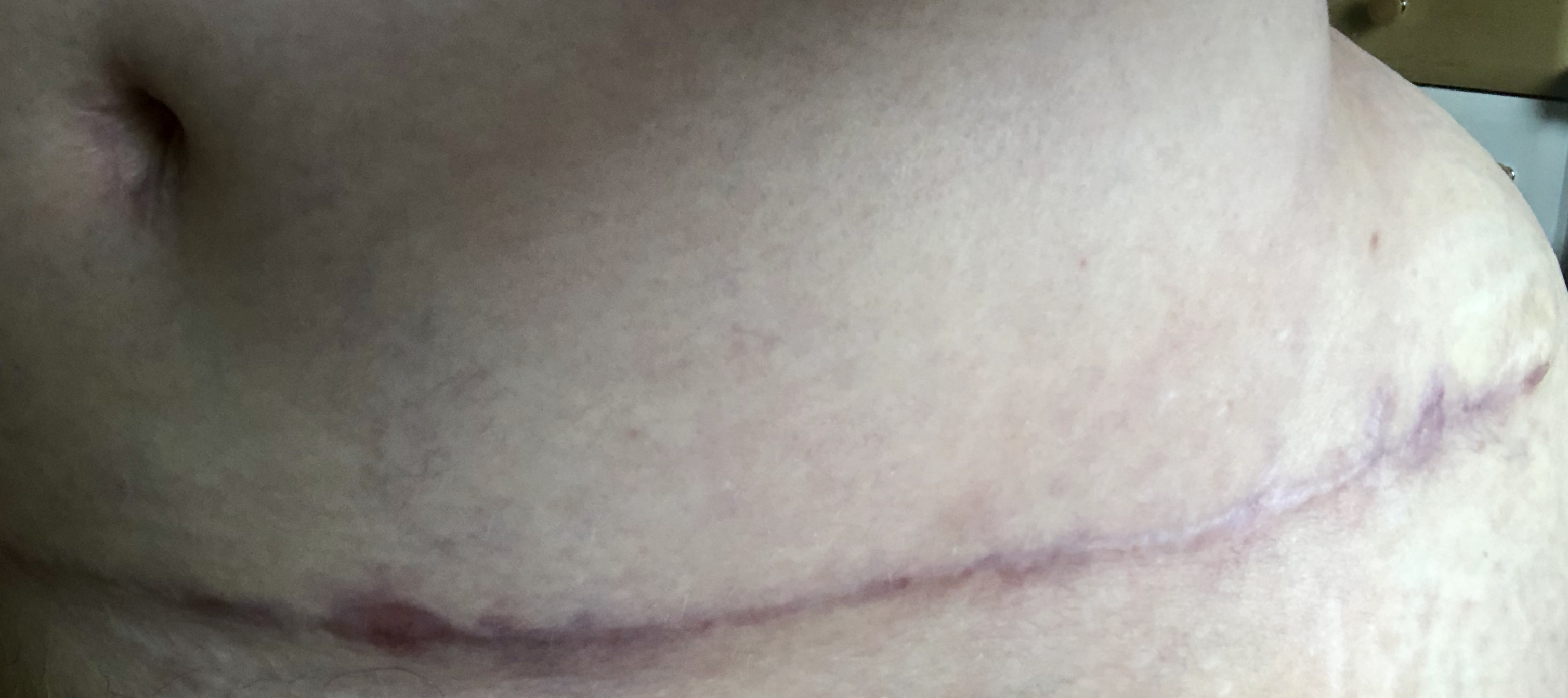 A year and a half later, my tummy still gets ‘sticky’ and sore both at the cut and under the skin that was separated, and starts to bloat. That middle section had very thin skin that was prone to tearing even a year after the operation - it took so long to close properly.
I need to exercise and move, and get regular lymph drainage massage still to make sure that area is well supplied with fresh blood and the fluid drains.
2026 - I still have problems with fluid not draining from my belly, left breast, arm and side, especially in warm weather. The breast still had very painful days. And there is a spot that they think is fibrous scar tissue from the top of the tummy fat they cut out for the breast that hurts constantly. It’s still being investigated. So, you never go ‘back to normal’.
Do breathing exercises
Not moving, staying bent, abdominal surgery, being in pain - all of these will make you breathe very shallowly.
Being mindful and trying to breathe deeply, or using any of the lung-exercising tools like the three-ball flow ‘toy’ will help.
I had to ‘practice’ with my lung ‘exerciser’ 4-5 times a day. Fun. (/sarcasm)
Get regular physiotherapy
Because you can’t/shouldn’t use your arm on your transplant side for quite some time, the muscles in your shoulder and back need help to get their range of movement and strength back. And, ongoing lymph drainage massage on the transplant, arm and belly helps to prevent oedema.
I’m still getting regular lymph drainage massage, and still need occasional help for my shoulders and neck.
Physiotherapy can also help soften scar tissue and prevent the additional adhesions that tend to form in operated parts.
The risk of all breast operations - fat necrosis
Part of the transplanted breast died on day 8 after the operation - maybe the heat had something to do with it. The outside of the breast suddenly swelled up and I developed a fever. The plastic surgeon came out of the middle of an operation to have a look, and decided the risks of cutting in again so quickly to see what happened was not worth the additional damage that would cause. Better to heal first, let things soften, then take another look.
The dead tissue in the outside of the breast was quite numb for many months, while the rest of the transplant was completely hard. As the haematomas started to ‘melt’ and be reabsorbed and the transplant got softer at about the 5 months stage, that bit of fat necrosis didn’t.
At 6 months, this solid lump pushed into my arm and had pinched a nerve in my chest. I couldn’t even hold my arm against my body, let alone type comfortably or do anything with my left arm in front of me. My arm was always held behind me, rotating my shoulder inwards, and it was doing terrible things to the tendon-based arthritis in my neck and back.
Fat necrosis is common, and almost always occurs after breast operations. It’s not bad or dangerous. But when it is a very large lump that pinches a nerve, it needs to be removed.
A second operation to remove the dead tissue
The local hospital’s breast clinic specialists (Schwarzwald-Baar-Klinikum) again gave the most terrible and completely unscientific advice: “Pomegranate juice and homeopathy will work just as well as chemotherapy”; and “This lump could be cancerous or something worse, and could kill you tomorrow - you need to get it out immediately, at best, today!” Ummm… oookay. I had had enough of the Villingen doctors’ malpractice.
So…. back to Berlin to see my original surgeons, both the oncologists and the plastic surgeons. Yes, it’s fat necrosis - it’s neither life-threatening nor urgent.
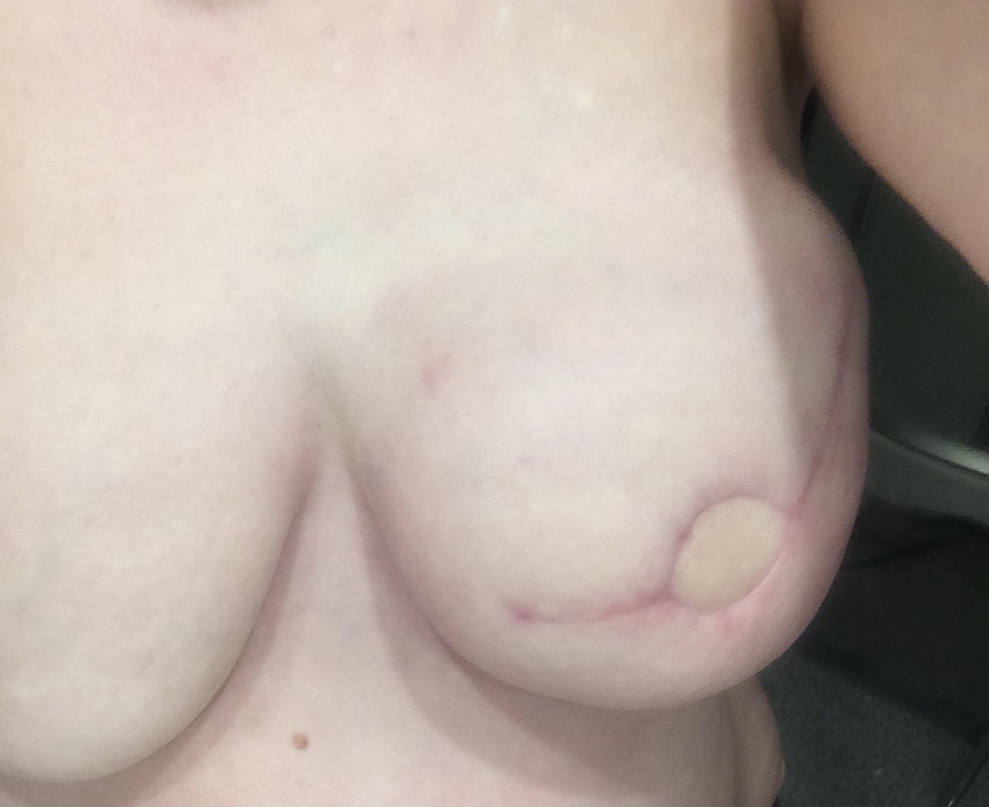 The planned operation was delayed at the last minute, thanks to my insurance provider. I had to get an additional assessment and approval from an independent assessor to prove it was not a cosmetic operation but rather medically necessary.
She only needed five minutes for the assessment - that outer quadrant houses a huge necrosis lump that compresses nerves, and needs to be operated come out.
The revision operation went ahead a few months later when they could fit me back into their schedule. It was a short operation of only 1.5 hours, no bed rest needed, and just a few stitches and tape to hold the cuts shut. I went down to the cafe to have a coffee that evening! They had ‘cleaned’ up my lymph removal scar too in case that had contributed to the nerve pain.
Tissue analysis revealed - yes, it was definitely fat necrosis, and no it was not dangerous at all. Luckily, they’d packed too much belly into the transplant, so cutting out the dead bit meant I ended up with a nearly matching-sized breast.
I went home a few days later, and this second operation healed well with no problems, and very little pain - much less than what the necrosis had caused for the past year!
A year and a half post-DIEP
I still have some hard lumps that are slowly softening - massive haematomas are slowly broken down and absorbed by the immune system. Of course, mine last longer because my immune system is stressed by the other auto-immune illnesses.
The first two mammograms were nerve wracking, but clear. There is no guarantee either tumour will reappear, in the other side, on the chest wall or metastasize to somewhere else. I’m due for my third soon.
I haven’t recovered feeling in my belly or my breast, which is quite disconcerting and needed time to adjust to. Being quite clumsy, I can’t feel how hard I bump or lean into things and have had more than a few bad bruises appear. The feeling probably will never return. Pimples are more likely on the transplant and take longer to heal due to the reduced blood supply. My skin reacts much more easily to things I’m sensitive to, like washing liquids and sweat.
The docs and physio have theorized that I may have developed an incisional hernia, probably through one of my old laparoscopy cuts, but it’s impossible to image. It’s not near any of the DIEP cuts, but stability was lost over the old laparoscopy incisions when they separated the skin and pulled it down for the DIEP. It’s worse when I bend and exert myself (washing floors), so I just have to be careful and keep an eye on it.
2026 - 9 years post DIEP: the couple of hard lumps under the breast never went away, and cause the radiologist to worry every year during the (painful!) mammogram and ultrasound checkup.
I can feel the titanium clips with my fingers at the top of the breast at times, and they can hurt every now and again, probably something to do with my inflammatory arthritis that affects tendons.
The nerves in my belly and breast never recovered - while it’s all mostly still numb, the nerves can fire randomly and intensely to fingernails, pressure or knocks.
The scar across my belly still pulls and occasionally the corners get infected.
The yearly mammograms are always very painful and nerve wracking for weeks prior.
Impact on other illnesses
I haven’t been able to start taking Humira (adalimumab) again for the spondyloarthritis (psoriatic), as the immune system needs to break down the haematomas and what’s left of the necrosis in the transplanted breast. Turn that immune system off and the lumps stay as they are, plus it risks more and worse infections. Stiff and sore is my new normal, and the local orthopaedic doctors refuse to prescribe physical therapies for arthritis (“go to a rheumatologist and get immune-suppressants” …. um, I can’t ‘cos of the breast cancer op!)
The costochondritis (as part of the arthritis) has also become harder to deal with, seeing as the transplant is essentially dead weight hanging off titanium clips in the chest muscles on one side. I have to resort to an ibuprofen when it’s too bad, otherwise, a massage chair, and a doubled massage ball on the wall while trying to breathe and heat packs are my go to tools.
The Reynaud’s has become so much worse. Stress? An argument? Immediate white fingers and toes. Too much typing? No blood in the hands! Cold weather? You don’t need your fingers! Sitting for just 15 minutes? You don’t need your feet!
Constant heat packs, hot water baths, and always raising feel when sitting is the only way around this. I have a portable hand-header and those disposable heat-packs where iron filings react with the oxygen for emergencies. Working in a normal office with a normal office chair is unthinkable at this stage. Or even travelling long distances without being able to put my legs up.
Not post-DIEP, but post-prednisolone, the rosacea and demodex-induced eczema is out of control and even affecting my eyes. Unfortunately, no doctor around here wants to try to treat it - the local dermatologist recommended to wash with plain soap twice a day and use an over-the-counter moisturiser. He just shrugged when I said I was already doing that.
So, tea tree oil, gentle cleansers, moisturisers, special eye wipes, and a whole lot of swearing because so far, nothing has worked. It wasn’t helped that my new glasses proved I had a allergy (the new silicone nose pads contain latex and plastic softeners, and made deep bloody holes where they were sitting on my nose)
Cosmetic tummy tucks and breast surgery? Insane!
Would I recommend a cosmetic tummy tuck? Absolutely no way! It’s a very difficult operation, with significant risks. You may end up with a flat belly, but also a mangled belly button, and permanently disconnected nerves. It’s not worth it. Plus, if you have struggled with putting on weight before the tummy tuck, you’ll struggle afterwards. I’ve put on 5 kg, which makes the cut across my tummy tighter, and probably has caused the incisional hernia. And in 2026, I have a lot more weight around the mid section, hips and butt thanks to the untreatable lipedema.
Also, never ever cosmetic breast procedures! The risk of necrosis is there, with any type of breast surgery. Of course, with legtimate (physical) medical reasons, most definitely recommended.
Would I recommend a DIEP?
Yes. With a caveat. If you have enough belly fat and are permitted to have a mastectomy instead of a lumpectomy, the combined mastectomy-DIEP in one operation is best in my opinion, although healing takes longer. If you have a DIEP transplant placed years after a mastectomy it is more difficult to get a ‘clean’ and well-shaped rebuild, and carries more risks of infections and additional necrosis risks.
Not having a rebuild? A lop-sided chest, especially with one large breast, puts mechanical strain on your posture, your neck, back, ribs, arms, shoulders, … With spondyloarthritis, I needed that rebuild so the spine would remain ‘even.
Had I been diagnosed with cancer in both breasts, the decision would have been much harder - a double mastectomy with no rebuild, or double mastectomy plus immediate DIEP on both sides? I probably would have chosen no rebuild, just the mastectomy, to reduce the strain on my inflamed spine and tendons from the far too heavy breasts.
What about the missing nipple?
I don’t miss it at all. It always hurt and turned inwards regularly. I have been asked many times about getting a tattoo of a nipple, but why on earth would I stick ink and needles in a spot that took so long to heal? That’d be asking for more problems!