Introduction to endometriosis and adenomyosis
What are endomeriosis and adenomyosis and what treatments are available?

This post will contain photos of the blood-filled endometriosis lesions taken from within my pelvis during several laparoscopies. Do not read this if you are squeamish!
What is endometriosis?
As endometrial tissue (the uterine lining) follows a cycle, getting thicker throghout the month then shedding/bleeding during menstruation, the endometrial growths outside the uterus bleed at the same time, into areas where blood isn’t meant to go, usually causing varying levels of pain and scarring.[1,2,4]
The scar tissue (or adhesions) are ‘sticky’ and often cause things like the ovaries and fallopian tubes to be joined to the wall of the pelvis, or the uterus, or the bowel/bladder etc. These should be free to move, and once stuck down, mobility is reduced and pain can be caused when the adhesions are stretched or broken.
Endometrial cells may form well-defined lesions and “chocolate” cysts (because the dark, old blood is a chocolate color). As the lesions grow, the endometriosis penetrates deeper into the abdominal cavity and tissue.
A good way to describe endometriosis, is that it is like a cancer - it is cells growing where they shouldn’t. It causes internal bleeding every period.
Where does endometriosis grow?
Endometriosis most commonly forms in the abdomen, the pelvic cavity, on the outside surface of the uterus, the walls of the abdomen, on the walls of the bladder and bowel, on the fallopian tubes and outer surface of the ovaries, and on any muscles and tendons that hold the organs in place. It will sometimes grow higher up on the kidneys and diaphragm. It can even grow in various other places around the body, like the lungs or the brain, but those cases are extremely rare.
In long-term serious cases, the endometriosis can penetrate the walls of the organs (bowel, bladder, etc.), requiring major surgery to remove the damaged sections and repair the organs.
It can occur alongside adenomyosis (pockets of malformed cells inside the wall of the uterus - causing pockets of blood to form during a period and restricts the utering muscle from contracting), fibroids, cysts, cancer, and various other pelvic problems. Patients with adenomyosis typically have extremely heavy and long periods, and can suffer from anaemia from the increased blood loss.
Stages of endometriosis
| Stage | Description |
|---|---|
| Stage 1 (minimal) | A few surface lesions and weak adhesions. |
| Stage 2 (mild) | Stage 1 lesions and adhesions, plus some deeper lesions. |
| Stage 3 (moderate) | Stage 2 plus more strong adhesions and endometriosis on the ovaries. |
| Stage 4 (severe) | Large areas covered with deep endometriosis, many strong adhesions. |
| (Stage 5 extreme) | Suggested by my surgeon—other organs involved, adenomyosis, surfaces covered in diffuse and deep endometriosis. |
What is adenomyosis?
Adenomyosis is similar to endometriosis, but the uterine cells that normally grow on the surface of the uterus grow inside the uterine muscle wall. Think of a severe bruise - you’ve broken blood vessels under the skin, but the blood can’t exit the skin. In adenomyosis, these cells bleed inside the muscle, but the blood can’t get past the muscle wall.
That means the uterine muscle swells with the captured blood, pressing on nerves causing a lot of pain, and it can’t contract properly to cleanly release the endometrial cells that are shed during a period. This is how the adenomyotic uterus causes extremely heavy and long periods.
One of my surgeons explained that it is like trying to spit cleanly when your mouth is full of marbles - having something in your mouth stimulates saliva production, and you end up dribbling and drooling everywhere uncontrollably.
Endometriosis symptoms
The symptoms of endometriosis may be chronic, throughout the month, or occur at specific times during the menstrual cycle. Most women who suffer from endometriosis have one or more of the following symptoms:
- debilitating menstrual cramps every month
- chronic pain throughout the monthly cycle (pelvis, abdomen and back)
- bowel and intestinal pain and symptoms, similar to IBS
- painful or urgent urination, similar to a urinary tract or bladder infection
- heavy, long or irregular periods
- pain or spotting during ovulation
- large blood clots during periods
- irregular spotting throughout the menstrual cycle
- pain during sex
It can cause infertility (many infertility patients have been found to have endometriosis, and once it is removed, have often been able to conceive), and debilitating pain.
Chronic pain can cause all number of other complications - damaged immune system and depression being the most common. The severity of the endometriosis is no indication of the level of pain (and vice versa). Some people get continuos pain, others only get it for 1-2 days at the start of their period, some don’t get pain at all, yet all could suffer endometriosis.
Who gets endometriosis?
It is estimated that up to 10% of women, or more - perhaps even 1 in 4, will suffer from endometriosis.[2,4] Doctors don’t know why some women get endometriosis and others don’t—the cause of endometriosis is currently unknown. It typically occurs between the ages of 13 and 50 (beginning menstruation until menopause).
Some studies have recently indicated that molecules from plastic that break down in heat can mimic estrogen and may contribute to hormone problems, such as endometriosis.[6]
Is endometriosis genetic?
There is some evidence that endometriosis may be hereditary—the risk of a person developing endometriosis is higher if their mother had endometriosis.[1]
Doctors have no idea what causes endometriosis, but you are more likely to get it if someone in your family has had it, and if you take a longer time to get pregnant. Detection and diagnosis is only certain with laparoscopic surgery and tissue analysis, although extremely bad cases may appear in ultrasound and MRI tests.
How is endometriosis diagnosed?
Until recently, if you had painful periods doctors often said “That’s normal”, or “It’s not painful”. Many still say this. They should lose their medical licenses.
If you do have painful periods, the tests you can do are:
- Ultrasound: This may have to be an internal ultrasound, which can be extremely painful, however the results rely on the quality of the equipment and the experience of the doctor reading the images, so it may not be very reliable.
- MRI: This is rarely used for endometriosis, more often for adenomyosis. This test is not subsidised by Medicare in Australia in any way, so is often prohibitively expensive. As with ultrasounds, decent results rely on the experience of the doctors evaluating the images, but may detect adenomyosis fairly reliably these days.
- Laparoscopy: Keyhole surgery (described below), is the most reliable method. The diagnosis still depends on the skill of the surgeon if the endometiosis is mild and hard to see.
- CA125 blood test: This is actually a cancer indicator that can sometimes be used to detect endometriosis, but is extremely unreliable. Cancer Antigen 125 is released from damaged ovaries, for someone who has never had cancer, the average level is under 35. For someone with cancer, the level would be at least 1500, and for endometriosis may be around 80, but it is a very imprecise test. More often it is used to monitor the endometriosis after diagnosis (to see if it goes up and down on removal, and may indicate when it grows back).
Endometriosis can only be diagnosed with 100% certainty via laparoscopy using a camera inserted into the abdomen via small cuts and a biopsy of tissue samples.[1]
Although improvements have been made in ultrasound and MRIs, they are unreliable.[2]
Unfortunately, my extreme endometriosis never appeared on any non-surgical test. The adenomyosis however, was clearly visible in doppler ultrasounds as blood-fed cysts. If only this technology had been available earlier in my life!
It takes on average, 8-10 years for doctors to take patients with period pain seriously before endometriosis is diagnosed. With 1 in 10 (or likely more) women having endometriosis, that’s abuse on a massive scale.
What does endometriosis look like?
You can only see endometriosis when you cut into the pelvis.
An endometriosis laparoscopy
The patient is given a general anaesthetic before the surgeon makes a few small incisions - at least one in the belly buton and one lower. Then the pelvic cavity is pumped up with gas. A camera with a flashlight can be used by surgeons as they investigate (through the belly button), and tools through the other ‘keyholes’ are manipulated to cut out or burn out endometriosis lesions.
At the end of the operation, an anti-adhesion powder may be blown into the cavity (it may or may not help prevent adehsions though!) Then the gas is extracted and the patient is sewn up.
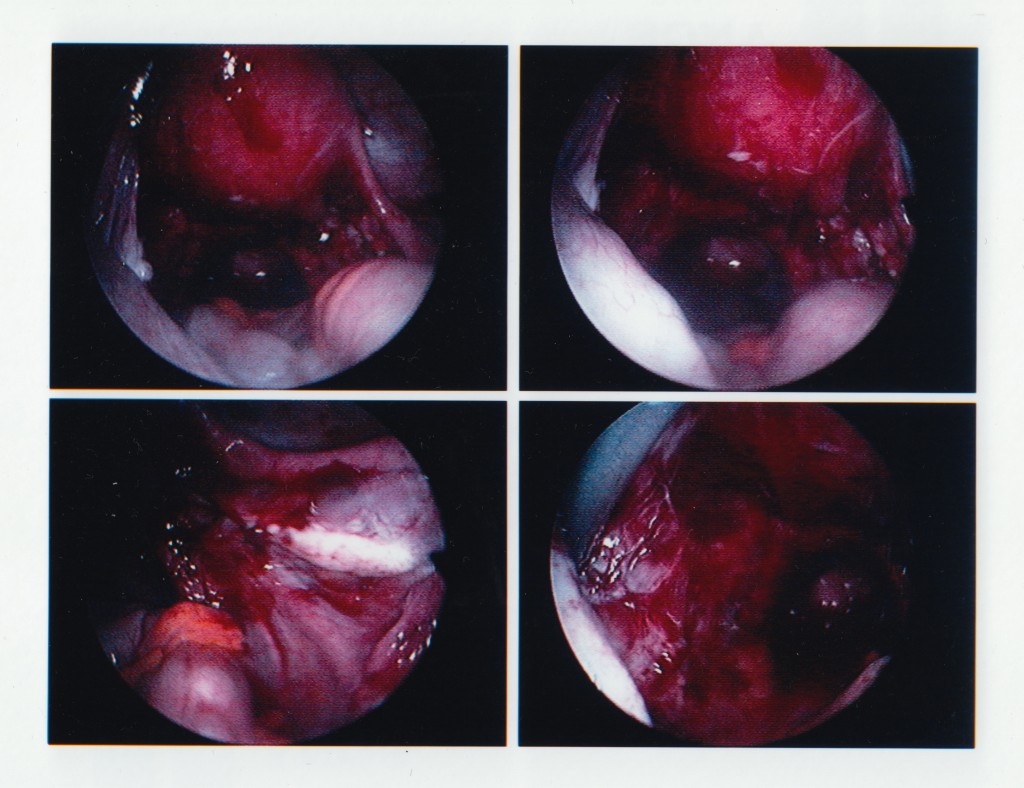
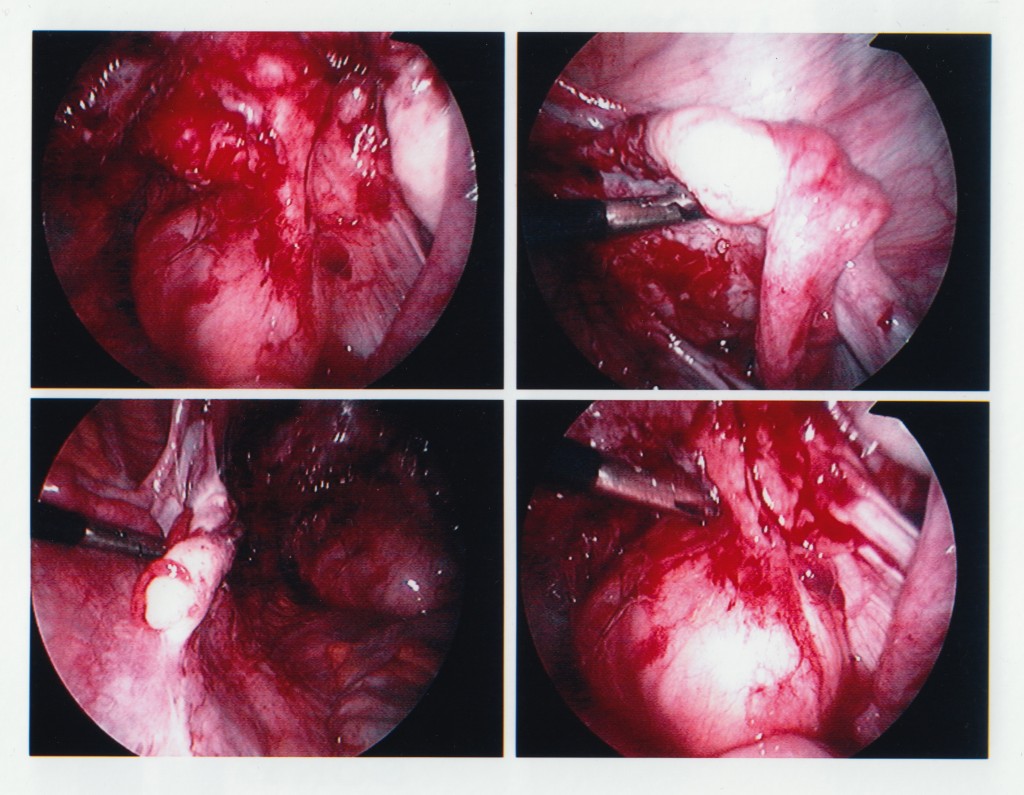
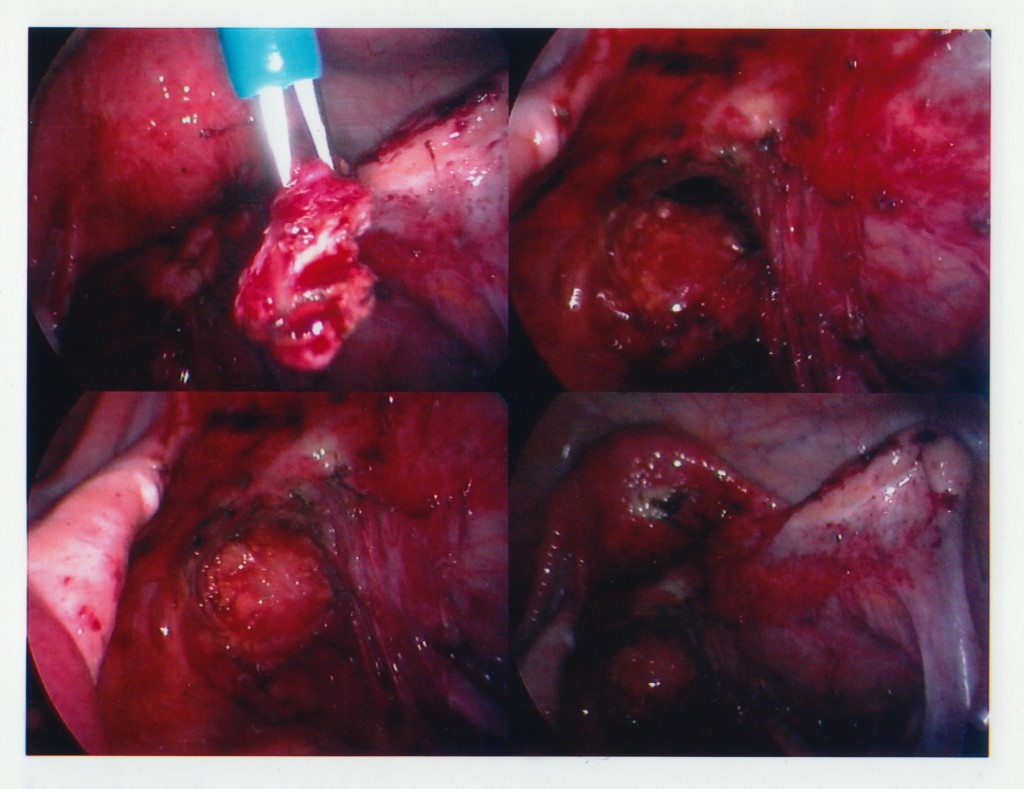
Stage 4 (5) endometriosis - bloody lesions, cysts and adhesions are smeared all over the inside of the pelvic walls and organs
What does adenomyosis look like?
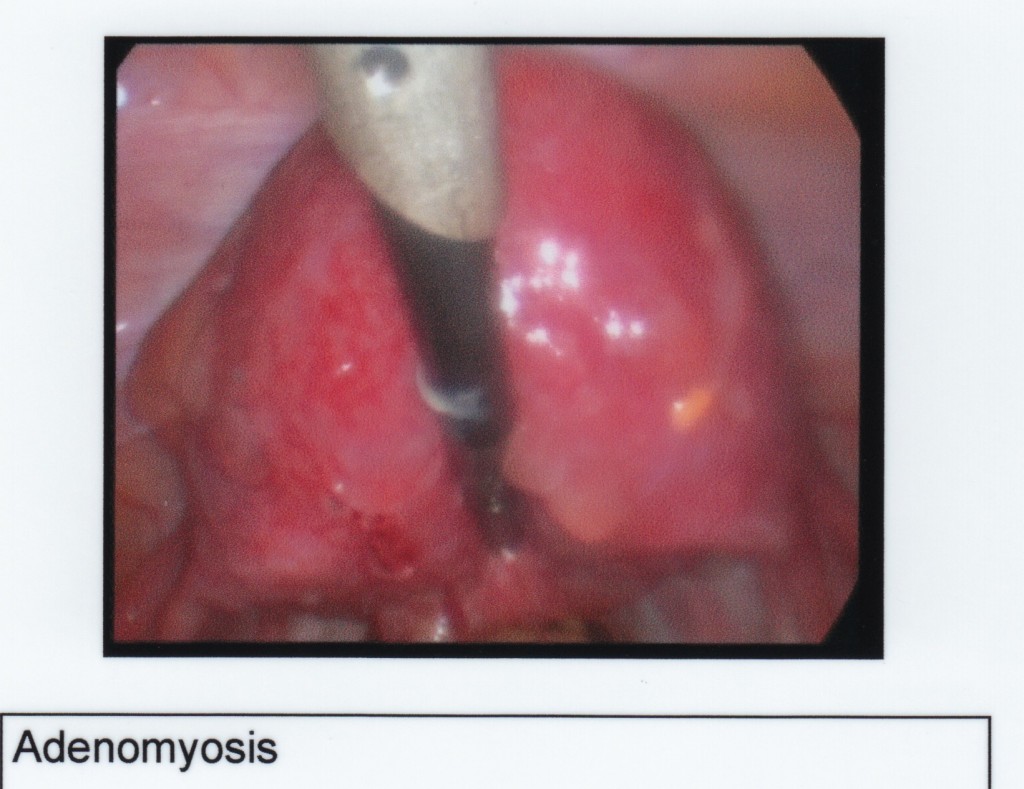 The outside wall of a uterus that contains adenomyosis lesions appears all lumpy and uneven - in the surgeon’s own words, “boggy”. Sometimes, these lesions or cysts can show up in ultrasounds and MRI tests as ‘blank’ spots. Or, with additional blood being supplied when scanning with the doppler ultrasound.
Surgeons can then take biopsies for the lab, samples from the uterine muscle where it is uneven, to see if adenomyosis/endometriosis cells are in the muscle.
How is endometriosis treated?
The preferred method of treatment is to surgically remove the growth during a laparoscopy, using scalpels and/or a laser.
A biopsy will typically be done on the growths when removed to test for cancer and to make sure it really is endometriosis (and/or adenomyosis in the uterine wall). Although endometrisis can grow back after it is removed within 6 months, and there are a number of treatments and medications to slow down this regrowth.
Endometriosis medications
Everyone must be made aware that the common hormonal treatments - the various contraception pills, Visanne, Mirena IUD, HRT, progesterone creams, etc. - may contribute to breast cancer and other gynecological cancers (cervical, uterine, ovarian).
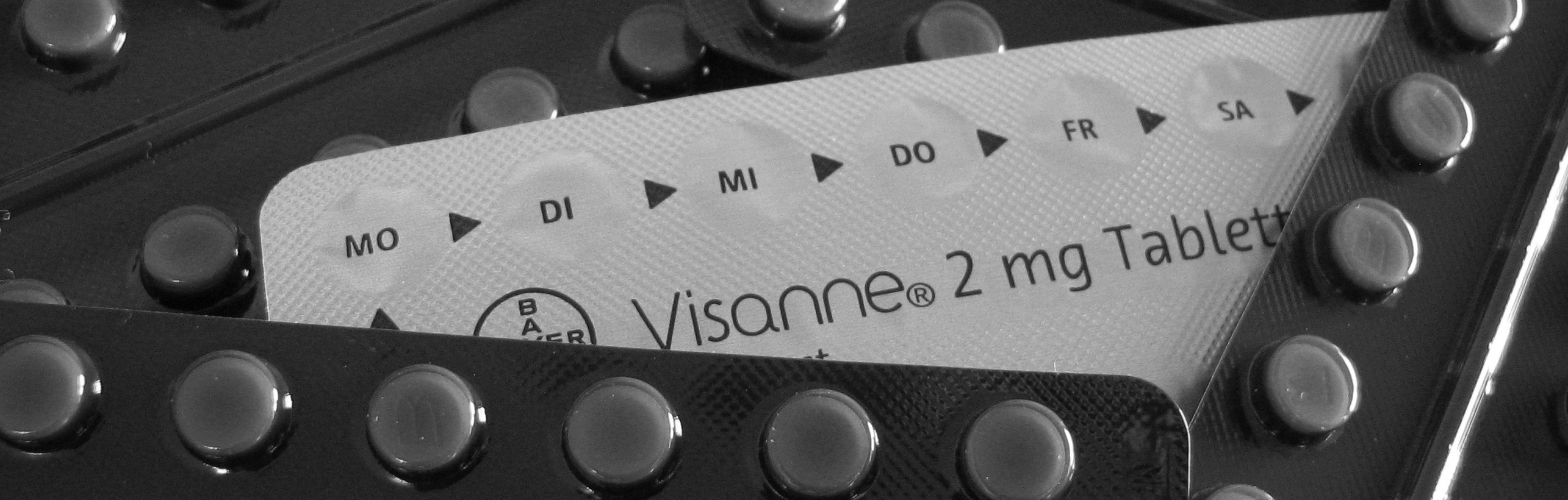 After surgery, the birth control pill or Visanne (progestin only pill) is often used to control the growth as higher levels of progesterone seem to inhibit endometriosis growth. Sometimes, the pill will be given to teens suffering symptoms as surgery is usually left until later to prevent scar complications on growing bodies.
If something prevents surgery - like too many blood vessels feeding the growths that would bleed too much if severed, a 3-6 month course of Lupron or Zolodex is administered. This artificially induces a menopause which shrinks the blood vessels feeding the growths, and sometimes even shrinking the growths. Both medications have long lasting side effects and should be used with care.
Treatment time for Zolodex can be 3-6 months, as anything over 6 months would cause osteoporosis. However, Zoladex courses over a longer period are now used to help prevent hormonal breast cancer recurrance.
Natural treatments for endometriosis?
Natural alternativesmay help with the symptoms. However, there is no scientific proof that they help with the disease or decrease the endometriosis growths.
Altering your diet to be healthy, full of whole foods, reducing or going no dairy, as well as no sugar, and maybe no wheat or no fat have reportedly helped a number of people. Individual case studies do not prove a treatment works, but as these changes are easy and accessible, there is no harm in experimenting with your diet yourself to see if it works.
Regular exercise and strength training is especially important for those who have been on Zolodex treatments to help prevent osteoporosis.
A natural progesterone cream is available, which many claim help with the pain (along the same lines as how the pill helps).
While one of my surgeons promoted a dairy free diet, acupuncture and Chinese herbal medicine as ‘good at controlling the regrowth and pain’, I never saw any change or improvement despite sticking with this expensive regime for two years.
How is adenomyosis treated?
For adenomyosis, the Mirena IUD can prevent the heavy bleeding and sometimes even stop periods completely. However, the levels of hormones it releases decrease over time, and should be replaced faster than if used purely for contraception (so, every 4 years instead of 5-10 as the gynecologists here wanted to enforce).
Endometriosis hell - my story
Doctors ignored my symptoms for a decade.
I had painful, heavy periods from the moment they started. I was told over and over again by doctors and family that the pain was either ‘normal’, or ‘all in my head’, and refused to investigate.
I was told painful, heavy periods were normal. Just put up with it.
At age 15, the monthly pain was so debilitating that doctors decided to ‘treat’ me with the contraceptive pill. At age 19–21, I bled and spotted constantly, every day for two years, breaking through all the medications that various gynecologists wanted me to try.
No doctor or specialist suggested endometriosis until I was 24, and a diagnostic laparoscopy was ordered.
The next two operations showed I had endometriosis, the worst that the surgeons had seen. A new stage of endometriosis was suggested because the lesions, cysts, adhesions and organ involvement were so severe.
The surgeons could not remove the growths because the endometrial cells were fed by a huge array of blood vessels.
Multiple chemical menopauses
To shrink the blood supply, making it safe to remove the endometrial growths that covered all the surfaces of my abdomen, I was put into a chemically induced menopause with a drug normally used to treat prostate cancer. The side effects were almost unbearable.
A third operation removed most of the endometriosis. After a few months of recovery, my pain pattern had changed (the pain was mostly at the end of menstruation) but had not improved.
I could not believe it when that top endometriosis surgeon told me the pain was “in my head”—imaginary pain.
Multiple surgeons
A new surgeon and another operation discovered extensive diffuse adenomyosis—the rogue endometrial cells had buried themselves deep into the uterus muscle wall. Such adenomyosis is only treatable with a hysterectomy, but I was only 26, far too young.
In addition to severe pain, adenomyosis causes infertility, high rates of miscarriage and birth defects due to the damaged muscle and an impaired blood supply.
Had doctors discovered and removed the endometriosis before it got so extreme, the adenomyosis would not have developed.
Permanent side effects and cancer
I have had to cope with constant, chronic, severe pain and heavy bleeding and undergo far too many endometriosis-removal operations before I was allowed to have a partial hysterectomy at age 39 and oopherectomy at at 47. They still wouldn’t take my ovaries out, because I am too young.
I was and am unable to have children due to the severe endometriosis and adenomyosis, because my period pain was ignored by doctors in my teenage years.
In treating the endometriosis conservatively with hormones (Zoladex, Lupron, Visanne and Mirena), I developed many lasting side effects. The worst of which were lasting lipedema, and two different types of breast cancer tumors in my left breast - requiring more operations, complications and even more chronic life-long pain.
Unfortunately, my story is far from unique.